Latest news
A mysterious portrait of Anne Boleyn returns to her childhood home
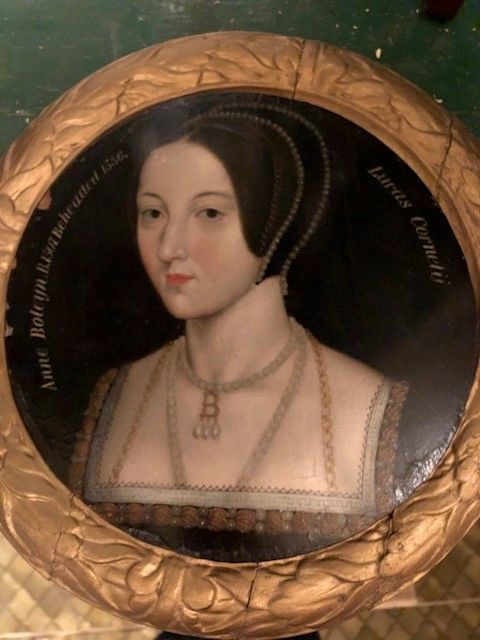
Could this really be Anne Boleyn? A mysterious Tudor portrait, preserved for centuries by the family of one of the queen’s closest connections, has returned to public view at Hever Castle.
The Romney Portrait, a small circular painting traditionally identified as Anne Boleyn, is being displayed as part of Capturing a Queen: The Image of Anne Boleyn.
The portrait has a remarkable story. It was passed down through the Wyatt family, descendants of Tudor poet Sir Thomas Wyatt, who was closely connected to Anne Boleyn, before passing by marriage into the family of the Earls of Romney, where it remains today.
At first glance, the painting appears to leave little doubt about the sitter. The woman wears Tudor dress, a black French hood and strings of pearls, while a pendant bearing the letter ‘B’ hangs around her neck. An inscription around the edge names her as “ANNE BOLEYN” and gives her dates as 1507-1536. It also names the artist as “LURAS CORNELLI”, thought to refer to Lucas Cornelisz, a painter who worked at the court of Henry VIII.
But there is a fascinating catch: we don’t know exactly when the portrait was painted – or whether it was painted during Anne’s lifetime.
The earliest known record of the painting dates to 1725, when it was documented in the possession of the Wyatt family. It was described as a portrait of Anne and presented to the Society of Antiquaries alongside a prayer book traditionally associated with the queen.
One possibility is that the portrait was created later, perhaps using an earlier image of Anne as its inspiration. Anne’s great-nephew, Sir George Wyatt, was fascinated by his family’s connection to the queen and wrote one of the earliest biographies of her. Could the portrait have been part of the family’s efforts to preserve Anne’s memory?
There is no definitive answer and that is what makes the Romney Portrait so intriguing.
“The Romney Portrait is fascinating because it looks like a straightforward portrait of Anne Boleyn, but its history raises so many questions” says Dr Owen Emmerson, Assistant Curator at Hever Castle.
“We know it was treasured by the Wyatt family and had been identified as Anne for centuries, but we don’t know exactly when it was painted or what image it was based on. It is a wonderful example of how Anne’s image has been passed down, interpreted and sometimes reinvented over the centuries.”
The portrait was last publicly exhibited in London in the early 1900s. Now, more than a century later, it has returned to public view at Anne Boleyn’s childhood home.
Displayed alongside other portraits and objects associated with the queen, the Romney Portrait forms part of Capturing a Queen, an exhibition exploring how Anne Boleyn’s image has evolved over almost 500 years.
Rather than offering a definitive answer to what Anne looked like, the exhibition invites visitors to examine the evidence and decide for themselves.
Capturing a Queen: The Image of Anne Boleyn is included with castle admission. For more information, visit www.hevercastle.co.uk.
Ends








Inspiration for your next adventure
Discover the fun and hidden side of Kent. Follow @KentAttractions on socials to stay updated.
